Scholarship Scams in Pakistan 2026: 10 Red Flags of a Fake Offer and How to Verify Any Scholarship
Every scholarship season brings two kinds of messages: real announcements, and offers built to take your money or your CNIC details. The second kind is common enough that the Higher Education Commission (HEC) has had to warn the public repeatedly. In a December 2024 notice, HEC said callers were claiming HEC affiliation to collect students' personal information, people posing as attestation agents were charging far above the official fees, and fake social media pages were promoting unauthorised services. HEC's position was that it employs no agents for attestation and does not make unsolicited calls about it.
This guide covers the red flags that give a fake offer away, a five-step check you can run on any scholarship before you share a document or a rupee, and what to do if you have already been caught. The red flags apply to scholarships anywhere; the reporting steps are specific to Pakistan.
Real vs Fake at a Glance
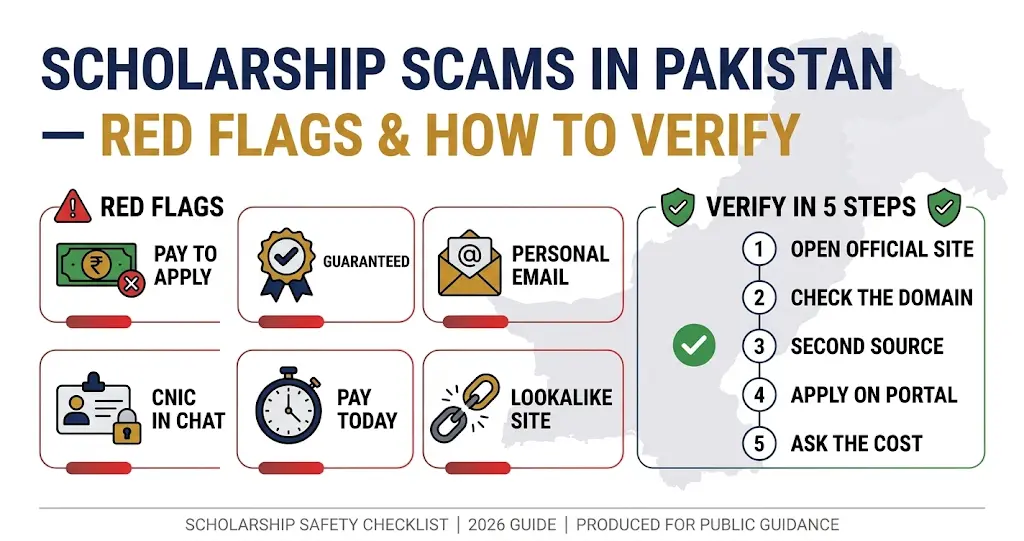
10 Red Flags of a Fake Scholarship Offer
- You are asked to pay to receive or "secure" the award. A scholarship gives you money; it does not take it. Scammers call the payment a processing fee, registration fee, refundable deposit or insurance. One distinction matters: a university may charge a normal admission application fee, paid to the university's own account. That is separate from the scholarship, and no genuine scholarship requires you to pay a person to be selected.
- You have "won" a scholarship you never applied for. A message saying you have been selected, usually by SMS or WhatsApp, with no application behind it is a hook. Government programmes get impersonated this way too: in a January 2024 statement, the Benazir Income Support Programme (BISP) warned that fake messages claim a stipend has been approved and ask for contact details to send money, and said its real messages come only from 8171. If you did not apply, you cannot have been selected.
- Selection is "guaranteed". No committee can promise a result before it has read your file. "100% selection", "guaranteed visa" and "scholarship plus admission guaranteed" are sales lines, not programme terms.
- The message comes from Gmail, Yahoo, a personal WhatsApp number or a Facebook page. Established programmes write from addresses on their own domain. A real organisation may run a WhatsApp channel or Facebook page, but the announcement will also be on its official website. If it is not, treat the post as unverified.
- The website is a lookalike. Read the address bar letter by letter. Pakistani government bodies use .gov.pk and universities use .edu.pk; a site claiming to be one of them with a different ending, extra hyphens or added words such as "hec-scholarship-apply" is a warning sign. Foreign programmes have their own official domains. Find that domain from the programme's own announcement or a second official source, never from the message you were sent.
- Sensitive details are requested early. Documents belong in the official portal, not in a chat with an individual. Nobody legitimate needs your OTP, PIN, wallet password or bank login to consider you for a scholarship, and a CNIC photo sent to a personal number is a CNIC you cannot take back.
- The money goes to a person. A request to send money to a personal bank account, an Easypaisa or JazzCash number in an individual's name, crypto or gift cards points to a scam. Any genuine payment, such as a university admission fee, goes to the institution's own account and comes with an official challan or receipt.
- You are pushed to act now. "Pay today or the seat goes to someone else", countdown timers and "only three seats left" are pressure tactics. Real deadlines are published in advance on the official page and do not move to suit the person asking for money.
- A middleman offers to do it for you. The official Türkiye Burslari site states that applications are free of charge, that no institution or person is authorised to apply for you, and that you should not entertain third parties who offer to apply in exchange for a fee. HEC says it employs no agents for attestation, so anyone offering to "fast-track" your degree attestation is not working for HEC. Genuine education consultants exist and can help with admissions, but nobody can sell you a scholarship outcome.
- You cannot find it on the awarding body's own website. No official page, no published eligibility, no deadline, no selection process and no programme office to contact; or an "offer letter" arrives but your name appears in no application portal. If the only trace of the scholarship is a forwarded message, it is unverified, however polished the PDF looks.
Why people pay twice. Scammers rarely ask for everything at once. A small registration fee is followed by a verification fee, then a visa or courier charge, and each payment makes the next feel like the price of not wasting what you have already spent. The first request is the one to refuse.
How to Verify Any Scholarship in 5 Steps
- Open the official site yourself. Type the organisation's address or search for its name, then check the domain of the result. Do not use the link in the message.
- Find the scholarship there. A genuine programme has an official page with eligibility, a deadline and an application route. Applications for HEC-managed programmes go through HEC's own scholarship portal (scholarship.hec.gov.pk).
- Cross-check with a second official source. Compare the details against HEC's announcement, the relevant embassy or high commission, or the university's own financial-aid page. A scholarship that exists in only one place, and that place is a message, fails the test.
- Apply only through the official portal, and track it there. An emailed or WhatsApp "offer letter" proves nothing. If you applied, your status is visible in the portal; if it is not there, the offer is not real.
- Ask what it costs and who gets paid. Contact the organisation using the details on its official website, not the ones in the message, and ask in writing. If the answer involves paying an individual, stop.
If You Have Already Paid or Shared Your Details
Act quickly, and do not pay anything further to "recover" your money. Be wary of anyone who offers to get it back for a fee.
- Stop contact and keep the evidence: screenshots of chats, phone numbers, account or wallet details, receipts and the website address.
- Tell your bank or mobile-wallet provider straight away. HEC's notice also points people who lose money to the State Bank of Pakistan.
- Report it to the National Cyber Crime Investigation Agency (NCCIA) on its cybercrime helpline, 1799, launched in June 2025.
- Report scam calls to your telecom provider's helpline so the number can be blocked, and complain to the Pakistan Telecommunication Authority (PTA) on its toll-free number 0800-55055, as HEC's notice advises.
- If you shared a password, OTP or PIN, change it now and switch on two-step verification where it is offered.
How OfficialRozgar Checks Scholarships
Every scholarship we publish ends at the awarding body's official portal, not a forwarded link, and we do not use third-party aggregator sites as sources. That does not replace your own check: open the official link, confirm the details match, and apply there. If anything on our site differs from the official page, email contact@officialrozgar.online and we will look into it.
Quick Answers
Is it normal to pay anything when applying for a scholarship? A university can charge an admission application fee, paid to its own account, and that is normal. The scholarship itself should be free to apply for; some programmes, such as Türkiye Burslari, say so explicitly. If the payment goes to a person, or you are told it "secures" the award, stop.
Is it safe to use a consultant or agent? Consultants can help with admissions and documents, but you do not need one to apply to the major government-funded programmes, and nobody can guarantee a scholarship. Get fees and refund terms in writing, and never pay anyone for a promised outcome.
Can I trust scholarship posts on Facebook pages and WhatsApp groups? Use them as a pointer, never as proof. Find the announcement on the official website before you act. The same goes for our posts: each one links to the official page, so check it.
Looking for scholarships to apply to? Browse our rozgar online scholarships section, or see how a verified listing is built in our Commonwealth Scholarship 2027 for Pakistan and Gates Cambridge Scholarship 2027 guides.
Last reviewed: 16 October 2026.